
Why “The First of the Five Sacred Mountains”

Geography & Geology

  • A vast rock mass rising dramatically above the North China Plain; a classic mountain-on-plateau profile.
  • Records nearly three billion years of Earth history in its rocks and landforms.
  • Altitudinal belts from mixed forests to summit shrubs create a compact biodiversity mosaic.

Civilization & Ritual

‘Wuyue Duzun’ stone inscription at Mount Tai / 泰山“五岳独尊”石刻
“Wuyue Duzun” stele along the ascent.
  • 12 historically recorded imperial ceremonies honouring Heaven and Earth.
  • ~1,800 stone tablets & inscriptions; 22 temples integrated into the landscape.
  • A continuous sacred status for more than three millennia; a touchstone for Confucian thought and state ritual.

Confucianism • Buddhism • Folk Belief

Confucian View from the Heights

Looking up at an archway on the Heavenly Street of Mount Tai / 泰山天街牌坊仰视

“To climb Mount Tai and see the realm as small” — the oft-quoted line (paraphrased from Mencius) turns the summit into a metaphor for moral breadth and clear sight. Steles and calligraphy along the ascent read like an open-air anthology.

Jingshiyu: Sutras on Stone

Along a granite stream-bed, large-character passages of the Diamond Sutra (Northern Qi period) were carved in situ. After rain, shallow flow over the glyphs creates a shimmering “chanting water” effect. Do not touch, rub, or step on inscriptions.

Bixia Yuanjun & “Taishan Shigandang”

At the summit, the Palace of the Clouds of Dawn venerates Bixia Yuanjun, a beloved deity of dawn, childbirth and protection. Across North China and overseas Chinese communities, stone tablets marked “Taishan Shigandang” guard lanes and thresholds — a practice inscribed on China’s national intangible heritage list (2006).


Routes & Viewpoints

Red Gate Night Hike

Misty stone steps near the Red Gate trail on Mount Tai / 泰山红门路线的雾中石阶
  • 4–6 h ascent • higher effort
  • Dense sequence of historic steles & gates
  • Best for culture lovers with good fitness

Tianwai Village → Mid-mountain

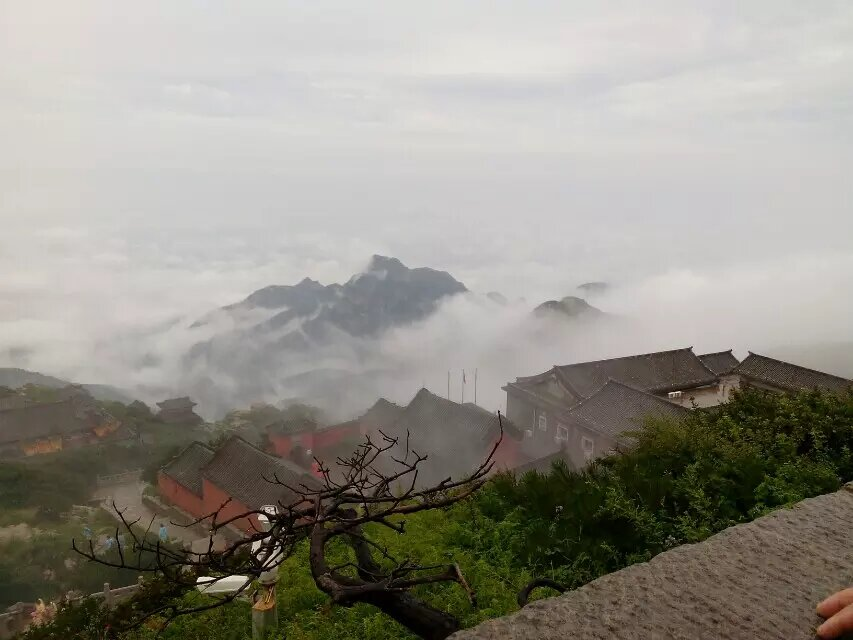
Rain-mist platform and halls on the mid-mountain route / 泰山中天门段雨雾平台与殿宇
  • Bus to Zhongtianmen, then hike 2–3 h
  • Saves time & energy; still scenic
  • Good for families/light hikers

Cable Car to South Gate of Heaven

Arch near the Heavenly Street close to the South Gate of Heaven / 南天门附近的天街牌坊
  • ~1 h to summit precincts
  • Check seasonal hours & maintenance
  • Suitable for seniors or tight schedules

Note: cable-car schedules can change; night operation is not guaranteed. Always carry layers — winds at the crest are sharp year-round.


Welfare & Etiquette (Do No Harm)

  • Stay on marked paths; do not cross barriers or climb gate roofs.
  • No rubbing, chalking or tracing of inscriptions; photography only.
  • Keep voices low at shrines; follow temple posted rules.
  • Pack out all waste; avoid drones unless explicitly permitted.

Practical Info (Official)

Official Notices & Maps

Before you go, check the scenic area’s official channels for opening times, weather advisories, transport and cable-car updates.

Parking at peaks and trailheads is limited on holidays. In Tai’an, the Taishan Easy Parking WeChat mini-program (泰山易停) offers live bay availability, navigation and payment.

Accessibility & Safety

  • Large elevation gain; pace yourself and hydrate.
  • Winter ice can persist on shaded steps — traction shoes help.
  • Respect closures and conservation zones.

Further Reading & Sources

  • UNESCO World Heritage Centre — Mount Taishan (criteria, brief synthesis, steps, ceremonies)
  • UNEP–WCMC World Heritage Datasheet — Mount Taishan (mixed property profile)
  • IUCN World Heritage Outlook — Mount Taishan
  • Academic & museum essays on the Jingshiyu Buddhist inscriptions (Northern Qi)
  • Background on Bixia Yuanjun and the “Taishan Shigandang” intangible heritage (2006 national list)

This page favours primary/official and peer-reviewed sources. When adding numbers, include the source and the update date.