

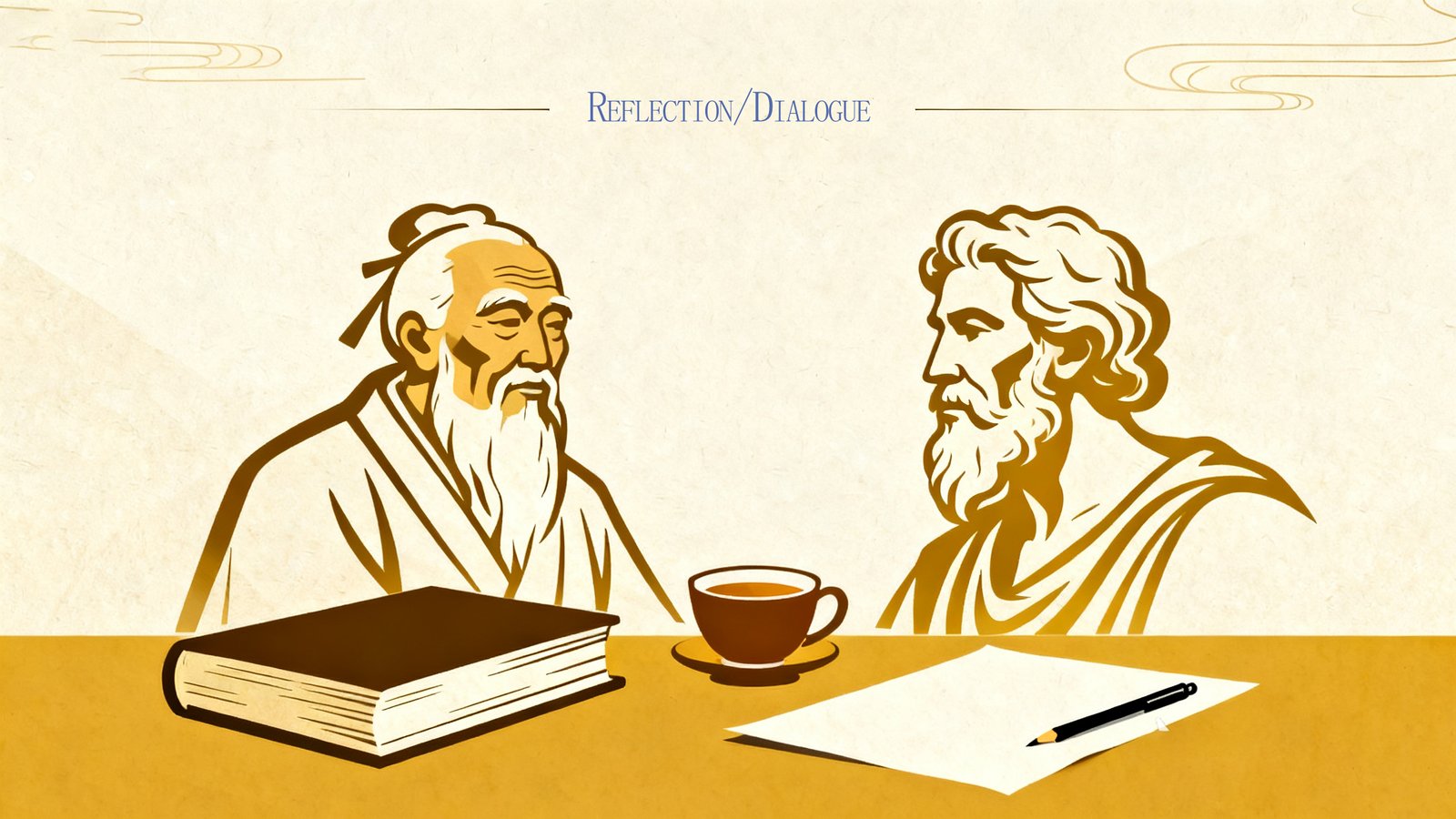
Why use questions to link traditions?
Story: Past midnight, you write: “How do I live with uncertainty?”
Insight: Answers differ; practice begins today. Method: articulate a lived question → co-read traditions → choose one controllable act.
One-minute micro-class (6)
Facing uncertainty
Daoism (Laozi): “In pursuing the Way one does less every day.” — DDJ 48 (D.C. Lau). [T1]
Zhuangzi: “Accept the season and dwell in accordance” and “sitting in forgetfulness”. [T7]
Stoicism: “Some things are up to us, others are not.” — Epictetus, Enchiridion 1.1. [T3]
Practice 60s: 4-4-8 breath; guide attention with DDJ 10.
Tomorrow action: repeat 4-4-8 once after opening email; note how your tone changes.
Happiness & meaning
Confucius: “The gentleman harmonizes, and does not merely agree.” — Analects 13.23. [T2]
Socrates: “The unexamined life is not worth living.” — Apology 38a. [T4]
Practice 60s: Write one sentence seeking harmony without mere conformity.
Tomorrow action: disagree once—gracefully—citing one precedent.
Anger & patience
Daoism: Act from alignment, not impulse (wu-wei as skilled ease). [S3]
Stoicism: “You have power over your mind…” — Meditations 12.36. [T5]
Practice 60s: Use the 4-4-8 breath; speak only after the exhale ends.
Tomorrow action: before replying to a tense message, do 1 breath cycle and re-read.
Success & failure
Confucius: “To see what is right and not do it is want of courage.” — Analects 2.24. [T6]
Stoicism: Measure success by what depends on choice (prohairesis). [S4]
Practice 60s: “Attentive presence” 3 minutes → split one goal into a verifiable next unit.
Tomorrow action: log one “in-my-control” unit by noon.
Community & ritual
Confucius: Ritual aligns feeling with form—begin with gratitude at the table. [T2]
Socrates: Dialogue as shared search. [T4]
Practice 60s: Before eating: bow; thank the chain of hands that brought the food.
Tomorrow action: ask one honest question more than you answer in a meeting.
Complexity & simplicity
Daoism: Subtract the unnecessary (DDJ 48). [T1]
Stoicism: Brief evening audit: in my control / not / tomorrow. [S5]
Practice 60s: Delete one commitment that isn’t yours; schedule one that is.
Tomorrow action: keep a 3-line audit before bed.
Practice toolkit
Stoic Premeditatio Malorum
Preview likely setbacks; write three if-then lines (If meeting is late → Then I draft notes; If criticism comes → Then I restate aim; If plan fails → Then plan B).
Attentive presence journal (Neo-Confucian)
Evening: (1) one moment of attentive presence; (2) one lapse; (3) one adjustment—apply step-by-step to tomorrow’s first action.
Cross-tradition dialogue
Functions & stance (comparison)
Confucius × Socrates: self-cultivation & relational ethics vs. elenchus & pursuit of truth—different social scripts (sayings vs. dialogues). [T2][T4]
Daoism × Stoicism: alignment with the Way (wu-wei as skilled ease) × training of choice/judgment (prohairesis). [S3][S4]
| Core metaphor | Water (flow/fit) | Fire (forge/reason) |
| Action | “Non-forcing” | Deliberate choice — disciplined assent |
| Ideal | Union with Dao | Virtue as knowledge |
Classic echoes (resonances)
Ritual & examination: Diotima’s ladder of love (Symposium) × Doctrine of the Mean “centrality & harmony” → elevation via dynamic balance. [T8][T9]
Acceptance & clarity: Zhuangzi’s “sitting in forgetfulness” × Stoic inner command → quiet lucidity for right action. [T7][S4]
Context rule: name era, audience and genre before comparing; otherwise, we mix apples and scrolls.
One-page classics (original · translation · practice)
Analects 13.23
“The gentleman harmonizes, and does not merely agree.”
Practice: Write one sentence that disagrees gracefully today.
Dao De Jing 48
“In the pursuit of the Way one does less every day.” — D.C. Lau. [T1]
Practice: Remove one step from a routine; keep the result if quality holds.
Enchiridion 1.1
“Some things are up to us, others are not.” — Robin Hard. [T3]
Practice: Name one thing you’ll carry lightly because it is not up to you.
Note: multiple authoritative translations exist; we name the edition used and keep quotations under 25 words.
Q&A: learn by asking
Ask a living question
Community highlights
Example 1: “I get angry at small things—what do Daoism and Stoicism say?”
- Daoism: Return to alignment first; breathe, then act from ease. [S3]
- Stoicism: Separate judgment from event; answer only after the breath. [S4][T5]
Example 2: “How can I be truthful yet kind at work?”
- Confucius: Keep trust with ritual tact; cite one precedent before disagreeing. [T2]
- Socrates: Ask one clarifying question; aim at the shared aim, not the person. [T4]
Reading list × city walks
Readings (editions we cite)
- Dao De Jing, tr. D.C. Lau — Penguin Classics. ISBN 014044131X. [T1]
- Zhuangzi, tr. Burton Watson (Columbia); tr. Brook Ziporyn (Hackett). [T7]
- Analects, tr. Edward Slingerland — Hackett, 2003. [T2]
- Meditations, tr. Gregory Hays — Modern Library, 2002. [T5]
- Epictetus, tr. Robin Hard — Oxford World’s Classics, 2014. [T3]
- Background: SEP entries on Chinese ethics, Daoism, Stoicism. [S1][S3][S4]
Pro tip: add library links / open resources later (e.g., Chinese Text Project, Internet Archive), so readers can preview before buying.
Walk & talk routes (curated, not for sale)
- Qufu half-day: Confucius Temple → Kong Mansion alleyways → a quiet tea stop. Read Analects 1.2 aloud.
- Shanghai “Ancient×Modern” walk: museum → bookstore → riverside bench. Journal one controllable action.
Accessibility: future images will use “place + action + feeling” alt text.
Sources & translation notes
- [S1] SEP “Chinese Ethics”.
- [S2] Hundred Schools (Warring States) and Han orthodoxy.
- [S3] Slingerland on wu-wei.
- [S4] SEP “Stoicism”.
- [S5] Stoic evening audit.
- [T1] Laozi (D.C. Lau).
- [T2] Analects (Slingerland / D.C. Lau).
- [T3] Epictetus (Robin Hard).
- [T4] Plato, Apology.
- [T5] Marcus Aurelius (Gregory Hays).
- [T6] Analects 2.24.
- [T7] Zhuangzi (Watson / Ziporyn).
- [T8] Doctrine of the Mean.
- [T9] Symposium.
Further materials
- Tu Weiming — embodied knowing.
- Wing-tsit Chan — bilingual Zhuangzi excerpts.
- Practice sheets: Stoic Premeditatio Malorum; Neo-Confucian daily log.
Direct quotes use published translations with translator credit; paraphrases marked editorial. Chapter/section numbers can be added per edition.